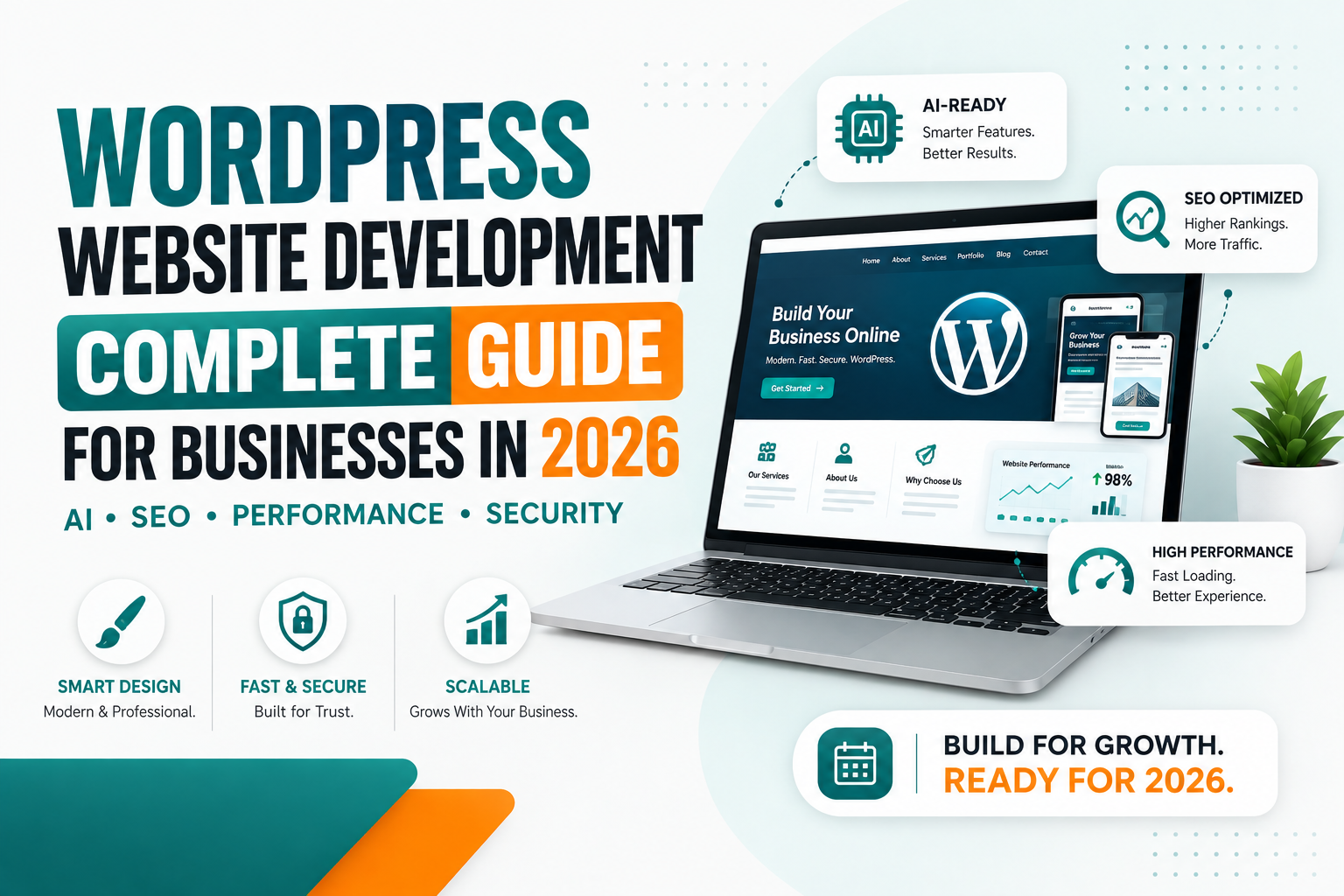
A business website is no longer just an online brochure. In 2026, your website can be one of your most important sales, marketing, and customer-acquisition assets.
Whether you run a local business, professional service company, eCommerce store, SaaS business, construction company, healthcare practice, or growing brand, the right website can help you attract visitors, build credibility, generate leads, and turn prospects into customers.
WordPress website development remains one of the most flexible ways to build that digital foundation. But modern WordPress development goes far beyond installing a theme and adding a few plugins.
A successful website needs strategy, user experience, performance, SEO, security, scalability, and conversion-focused development.
In this guide, we’ll explain what businesses should know about WordPress website development in 2026, what a professional website should include, how much development can cost, and how to choose the right development approach.
What Is WordPress Website Development?
WordPress website development is the process of planning, designing, developing, customizing, optimizing, and maintaining a website using WordPress.
It can range from a simple business website to a highly customized digital platform with advanced functionality.
A professional WordPress development project may include:
- Website strategy and architecture
- UI/UX design
- Custom WordPress development
- Responsive design
- Custom themes
- WooCommerce development
- Custom post types and fields
- Third-party integrations
- SEO-friendly architecture
- Performance optimization
- Security configuration
- Analytics and conversion tracking
- Ongoing maintenance
The important distinction is between building a WordPress website and building a website around business objectives.
A professional development process starts by understanding the company’s audience, goals, competitors, services, content, and conversion journey.
Why Do Businesses Still Choose WordPress in 2026?
WordPress remains attractive because it offers businesses a combination of flexibility, customization, content management, and scalability.
A company can start with a relatively straightforward website and expand it as its requirements change.
For example, a service business might begin with:
- Home
- About
- Services
- Contact
- Blog
Later, it may need landing pages, case studies, appointment systems, CRM integrations, custom forms, multilingual content, or advanced lead-generation functionality.
An eCommerce business can similarly expand from a basic product catalog into a sophisticated WooCommerce store with payment gateways, shipping integrations, product filters, customer accounts, automation, and analytics.
This flexibility is one of the biggest reasons WordPress continues to be relevant for businesses.
What Should a Modern WordPress Business Website Include?
A professional website should be designed around the customer’s journey rather than simply filling pages with information.
1. Clear Website Architecture
Visitors should immediately understand:
- What your company does
- Who you serve
- What makes you different
- What services or products you offer
- Why they should trust you
- What they should do next
Your navigation, page structure, headings, and internal links should make this journey easy.
2. Responsive Design
Most customers will interact with your business through different screen sizes.
Your website should provide a consistent experience across:
- Desktop
- Laptop
- Tablet
- Smartphone
Responsive development should not simply shrink a desktop design. Layouts, typography, navigation, buttons, images, forms, and content should be intentionally optimized for smaller screens.
3. Fast Performance
Website speed directly affects user experience.
A slow website can increase frustration and make visitors leave before they contact you or complete a purchase.
Performance-focused WordPress development can involve:
- Optimized images
- Efficient code
- Reduced unnecessary scripts
- Proper caching
- Optimized CSS and JavaScript
- Better hosting configuration
- Content delivery networks
- Database optimization
Performance should be considered during development rather than treated as an emergency fix after launch.
4. SEO-Friendly Structure
Search engine optimization should begin while the website is being developed.
A technically sound WordPress website should have:
- Logical URL structures
- Proper heading hierarchy
- Crawlable pages
- Mobile-friendly layouts
- Optimized images
- Internal linking
- XML sitemap
- Canonical URLs
- Appropriate structured data
- Fast-loading pages
However, technical SEO alone isn’t enough.
Businesses also need genuinely useful content that demonstrates expertise and answers the questions their potential customers are searching for.
Custom WordPress Development vs Pre-Built Themes
One of the biggest decisions businesses face is whether to use a pre-built theme or develop a more customized solution.
Pre-built themes can be useful when the requirements are simple and the budget is limited.
However, businesses with unique branding, functionality, performance requirements, or long-term scalability needs may benefit from a custom approach.
With custom WordPress theme development, the website can be built specifically around the company’s design, content structure, functionality, and performance requirements.
This can reduce unnecessary features and provide greater control over the final product.
The right approach depends on the project. A professional developer should recommend the technology based on the business requirements rather than forcing every client into the same solution.
WordPress and WooCommerce for Online Stores
For businesses selling products online, WordPress can be combined with WooCommerce to create a flexible eCommerce platform.
A professional WooCommerce website can include:
- Product catalogs
- Product variations
- Advanced filtering
- Shopping carts
- Customer accounts
- Payment gateways
- Shipping options
- Coupons
- Inventory management
- Order management
- Analytics
- Marketing integrations
The goal shouldn’t simply be to make products available online.
The entire shopping experience should be designed around usability and conversion.
Businesses planning an online store should consider professional WooCommerce development when their requirements go beyond a basic store setup.
WordPress SEO in 2026
SEO is becoming increasingly competitive.
Publishing hundreds of generic articles isn’t a reliable strategy. Businesses need content that provides real value, demonstrates expertise, and satisfies search intent.
A strong WordPress SEO strategy combines:
Technical SEO:
A crawlable, fast, secure, mobile-friendly website.
On-page SEO:
Well-structured titles, headings, content, images, metadata, and internal links.
Content strategy:
Articles that answer genuine questions and target relevant search intent.
Authority:
Useful resources, case studies, industry expertise, and credible references.
Conversion optimization:
Clear calls to action that turn organic visitors into leads or customers.
This is why website development and SEO should work together rather than being treated as completely separate activities.
For businesses looking to improve their organic visibility, SEO & website optimization can be integrated into the development strategy from the beginning.
How Much Does WordPress Website Development Cost in 2026?
There isn’t one fixed price for WordPress development.
The cost depends heavily on the scope and complexity of the project.
Factors can include:
- Number of pages
- Custom design requirements
- Development complexity
- WooCommerce functionality
- Third-party integrations
- Custom fields
- API integrations
- SEO requirements
- Content migration
- Performance optimization
- Security requirements
- Ongoing maintenance
A simple business website and a complex eCommerce platform may both use WordPress, but they can require completely different levels of development.
Instead of choosing a developer solely based on the lowest price, businesses should consider the website’s expected business value.
A website that consistently generates qualified leads or online sales can be considerably more valuable than a cheaper website that simply exists online.
When Should You Hire a Professional WordPress Developer?
DIY website builders can work for individuals and very small projects.
Professional WordPress development becomes particularly valuable when:
- Your business depends on online leads
- Your existing website looks outdated
- Your website is slow
- Your site isn’t mobile-friendly
- You need custom functionality
- You require WooCommerce customization
- Your SEO performance is poor
- You need integrations with other platforms
- You are redesigning an established website
- You need ongoing technical support
An experienced developer should do more than write code.
They should understand how design, technology, SEO, user experience, and business goals fit together.
The WordPress Development Process
A structured development process helps reduce mistakes and unnecessary revisions.
Step 1: Discovery and Strategy
First, the business goals, target audience, competitors, content requirements, and functionality are identified.
Step 2: UX and Design
The website structure and user journey are planned before development begins.
Step 3: WordPress Development
The approved design is transformed into a responsive WordPress website with the required functionality.
Step 4: SEO and Performance Optimization
Technical foundations, page structure, performance, responsiveness, and SEO elements are reviewed.
Step 5: Testing
Forms, links, layouts, browsers, mobile devices, user journeys, and important functionality are tested.
Step 6: Launch
After final checks, the website is deployed and connected with the necessary analytics and business tools.
Step 7: Ongoing Growth
A website shouldn’t be considered finished forever.
Regular updates, security checks, content improvements, SEO, performance optimization, and new functionality can keep the website effective as the business grows.
Why Choose SFAISAL DESIGNS for WordPress Development?
At SFAISAL DESIGNS, the focus is not simply on creating attractive websites.
The goal is to create digital experiences that support business growth.
The development approach combines:
- Custom WordPress development
- Responsive UX
- SEO-ready architecture
- Performance-focused development
- WooCommerce expertise
- Custom functionality
- Conversion-focused design
- Ongoing technical support
The company also works across industries including eCommerce, healthcare, technology, construction, real estate, and local businesses.
If your existing website needs modernization, SFAISAL DESIGNS also provides website redesign services focused on improving design, performance, usability, and SEO without unnecessarily sacrificing existing content or search visibility.
Final Thoughts
WordPress website development in 2026 is about much more than installing WordPress and selecting a theme.
A successful business website needs a clear strategy, professional UX, responsive development, strong performance, SEO-friendly architecture, security, useful content, and a clear conversion path.
The best website is not necessarily the one with the most features.
It’s the one that effectively helps a business achieve its goals.
Whether you’re launching a new company website, redesigning an outdated site, building a WooCommerce store, or creating a custom WordPress solution, the development decisions you make today can influence your website’s performance and growth for years.
If you’re ready to build a WordPress website designed around your business objectives, explore SFAISAL DESIGNS’ WordPress development services or get in touch to discuss your project.