One of the first decisions in any website project isn’t about color or layout — it’s about structure. Should your business have a single-page website, or a full multi-page site with dedicated sections for services, about, and contact? Both are legitimate, widely used approaches, but the wrong one for your specific business can quietly cost you leads, search visibility, and credibility. This guide breaks down exactly how to decide, with a real project example rather than just theory.
What A Single-Page Website Is
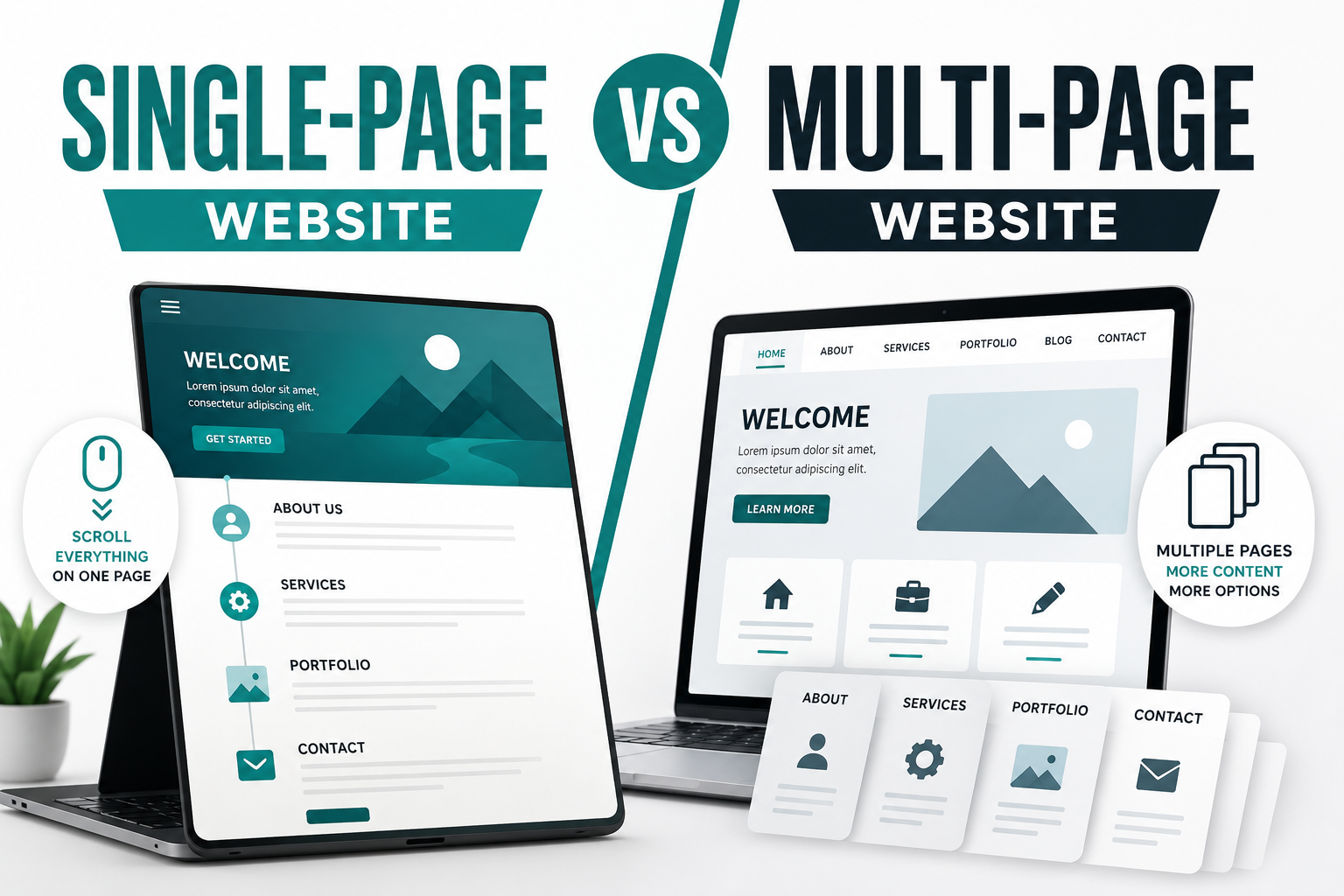
A single-page website presents everything — your services, your story, your work, your contact form — as sections on one continuous page, usually navigated by scrolling or jumping to anchor links. There’s no clicking through to separate URLs for “About” or “Services.” The entire experience is designed as one continuous narrative that moves a visitor from introduction to action.
We used this exact approach for Ironclad Construction Group, a construction company that needed to launch fast with a site that felt as solid and considered as their actual project work. A single page meant zero navigation friction — a visitor lands, scrolls, and reaches a clear call to action without ever having to decide where to click next. For a business with one core offering and one primary goal — getting a quote request — that simplicity was exactly the point.
Advantages of a single-page website
- Faster to build and launch. Less content to structure and fewer templates to design means shorter project timelines.
- Lower bounce risk from confusing navigation. There’s nowhere to get lost — the whole story is right there.
- Naturally mobile-friendly. Scrolling is the most intuitive mobile interaction, so single-page sites often feel more native on phones.
- Forces a clear narrative. Because everything has to fit into one flow, single-page sites tend to avoid the vague, scattered messaging that multi-page sites sometimes accumulate over time.
Limitations of a single-page website
- Limited SEO targeting. A single page can only realistically rank for a small number of closely related keywords.
- Harder to scale. As a business grows and adds services, a single page can become bloated or lose its focus.
- No home for ongoing content. Blog posts, case studies, and detailed service breakdowns don’t fit naturally into a one-page structure.
What A Multi-Page Website Is
A multi-page website splits content into dedicated pages — Home, Services, Industries, Case Studies, Blog, Contact — each with its own URL and its own purpose. This is the structure behind sites like our own service pages (Website Development, WooCommerce Development, SEO & Website Optimization) and industry pages (Construction, Healthcare, Real Estate, Technology & SaaS).
Rather than trying to compress everything into one scroll, a multi-page site lets each topic breathe — and lets each page be built specifically to answer the questions of the visitor who lands on it.
Advantages of a multi-page website
- Stronger SEO potential. Each page can target its own specific keyword, rather than competing with every other topic on a single page.
- Better suited to multiple offerings. A business with several distinct services or that serves several industries can give each one the depth it actually deserves.
- Room to grow. New services, new case studies, and new blog content all have a natural home without disrupting the rest of the site.
- Supports a longer decision process. Visitors who need to research before committing — which describes most B2B and considered purchases — get more to evaluate.
Limitations of a multi-page website
- Longer to build. More pages means more content, more design decisions, and typically a longer project timeline.
- Risk of navigation complexity. Poorly planned multi-page sites can bury important information behind too many clicks.
- Requires more ongoing content strategy. To make the most of multiple pages, you generally need a plan for producing content over time, not just at launch.
The SEO Difference Most Businesses Miss
This is where the decision matters most, and it’s the part most business owners underestimate. A single-page site can only realistically target one or two primary keywords — every section is competing for the same page’s authority in Google’s eyes. A multi-page site lets each page own a specific keyword: your WooCommerce Development page can rank for “WooCommerce development services” while your SEO page separately ranks for “SEO and website optimization” — without either page diluting the other or competing against itself.
Search engines evaluate relevance largely at the page level, not the site level. A page entirely focused on one topic, with headings, content, and internal links all reinforcing that topic, will generally outperform a section of a longer page trying to cover the same ground alongside five other unrelated topics. If your business offers several distinct services and you actually want each one to be discoverable in search — not just visible to someone who already found your homepage — a multi-page structure isn’t just a design preference. It’s a search visibility requirement.
This is also why industry-specific and service-specific pages matter so much for B2B and local businesses. A construction company that only has a single homepage will struggle to rank for “construction website design” and “commercial contractor website” and “residential builder marketing” all at once. Split those into dedicated pages, and each one has a real chance to rank on its own.
Real-World Scenarios: Which Fits Your Business?
A single service, one clear action needed — like a local contractor, a personal trainer, or a single-product launch. A single-page site is usually the right call. Ironclad Construction Group is a good example: focused offering, one clear next step (request a quote), fast launch needed.
Multiple distinct services or industries served — like a web agency (this is exactly why sfaisaldesigns.com uses a multi-page structure with separate pages for each of the 6 services and 6 industries), a healthcare practice with multiple specialties, or a real estate agency with different property types. Multi-page is close to mandatory here, both for usability and for SEO.
A SaaS or technology company — almost always multi-page, since different features, pricing tiers, and use cases each need dedicated space to be explained properly to a technical, research-driven buyer.
An eCommerce or retail store — inherently multi-page by nature, since each product or category needs its own page both for browsing and for SEO.
A personal brand or freelancer with one core offer — often works well as a single page, especially if the goal is simply to build credibility and capture contact requests quickly.
The Middle Ground: Most Growing Businesses Actually Need Both
In practice, the strongest approach often isn’t purely one or the other. Many of the sites we build combine a focused, single-page-style homepage — clean, fast, one clear story — with dedicated deeper pages behind it for services, industries, and case studies. Visitors who just want the quick pitch get it immediately on the homepage; visitors who want to research a specific service, browse a specific industry’s use case, or see real proof of past work can go deeper into the multi-page structure behind it.
This hybrid approach captures the best of both: the immediate clarity of a single-page experience for casual visitors, and the SEO depth and research support of a multi-page structure for visitors who need more before deciding.
Common Mistakes To Avoid
Choosing single-page purely because it seems “simpler.” Simplicity for the business owner isn’t the same as simplicity for the customer — if your services are genuinely varied, cramming them onto one page creates confusion, not clarity.
Building a multi-page site with no content plan. A multi-page structure only pays off if the pages are actually filled with real, useful, distinct content. A multi-page site with thin, repeated content across pages performs worse than a well-built single page.
Ignoring how customers actually research your type of business. A fast, low-consideration purchase (a haircut, a quick repair) suits single-page. A high-consideration purchase (a new website, a major renovation, enterprise software) suits multi-page, because customers expect — and need — more to evaluate before committing.
How To Decide For Your Business
Ask yourself these questions:
- Do I offer one service or several? One → single-page is worth considering. Several → multi-page.
- Am I trying to rank for multiple different search terms? If yes, you need multiple pages to target them properly.
- How fast do I need to launch? Single-page builds are typically faster to design and develop.
- Will I be publishing content regularly? Blogs and case studies need a multi-page structure to house them.
- What does my customer’s decision process look like? A quick, simple purchase favors single-page. A considered, research-heavy decision favors multi-page.
- Do I serve more than one type of customer or industry? If different audiences need different messaging, they generally need different pages.
Our Take
Neither structure is inherently better — the right choice depends entirely on what your business sells, who it sells to, and how customers decide to buy it. What matters is that the decision is made intentionally, based on your actual goals and SEO strategy, not just personal preference or whatever structure happens to look trendy. A well-built single page can outperform a poorly planned multi-page site, and vice versa — the structure is only as good as the thinking behind it.
Frequently Asked Questions
Can I start with a single-page site and expand to multi-page later? Yes. It’s common to launch fast with a focused single-page site and expand into dedicated pages as the business grows and content needs increase. This is often a smart way to get to market quickly without overbuilding before you know what content actually resonates.
Is a single-page website worse for SEO? Not inherently worse, but more limited. A single page can only realistically target a small number of keywords, while a multi-page site allows each page to rank for its own specific search terms. For a business with one narrow offering, this limitation matters less.
Which type of website is faster to build? Single-page websites are typically faster to design and develop, since there’s less content to structure and fewer templates to build. A multi-page site with 8-12 pages naturally takes longer, both in planning and execution.
Can a single-page website still rank well in Google? Yes, particularly for a focused, local, or niche business without much need to target multiple different search terms. The key is making sure the single page still follows solid on-page SEO practices — proper headings, fast load times, and genuinely useful content.
What did you choose for Ironclad Construction Group, and why? A single-page structure, because the business offered a tightly related set of construction services and needed a fast, focused site with one clear path to requesting a quote — not a large content library or multiple distinct service targets to rank for separately.
How many pages should a multi-page website have? There’s no fixed number — it should match how many genuinely distinct topics, services, or audiences your business needs to address. A common starting structure includes Home, About, Services (with sub-pages per service), Case Studies or Portfolio, Blog, and Contact.