Choosing the right website platform can have a major impact on your business. It affects how your website looks, how much control you have, what you can customize, how easily you can scale, and how much you’ll spend over time.
Two of the biggest options in 2026 are WordPress with WooCommerce and Shopify.
Both platforms are capable of powering successful online businesses, but they are built around different philosophies. WordPress gives you an open, highly customizable website ecosystem, while Shopify provides a more managed commerce platform with hosting, checkout, security, and many ecommerce features integrated into one service.
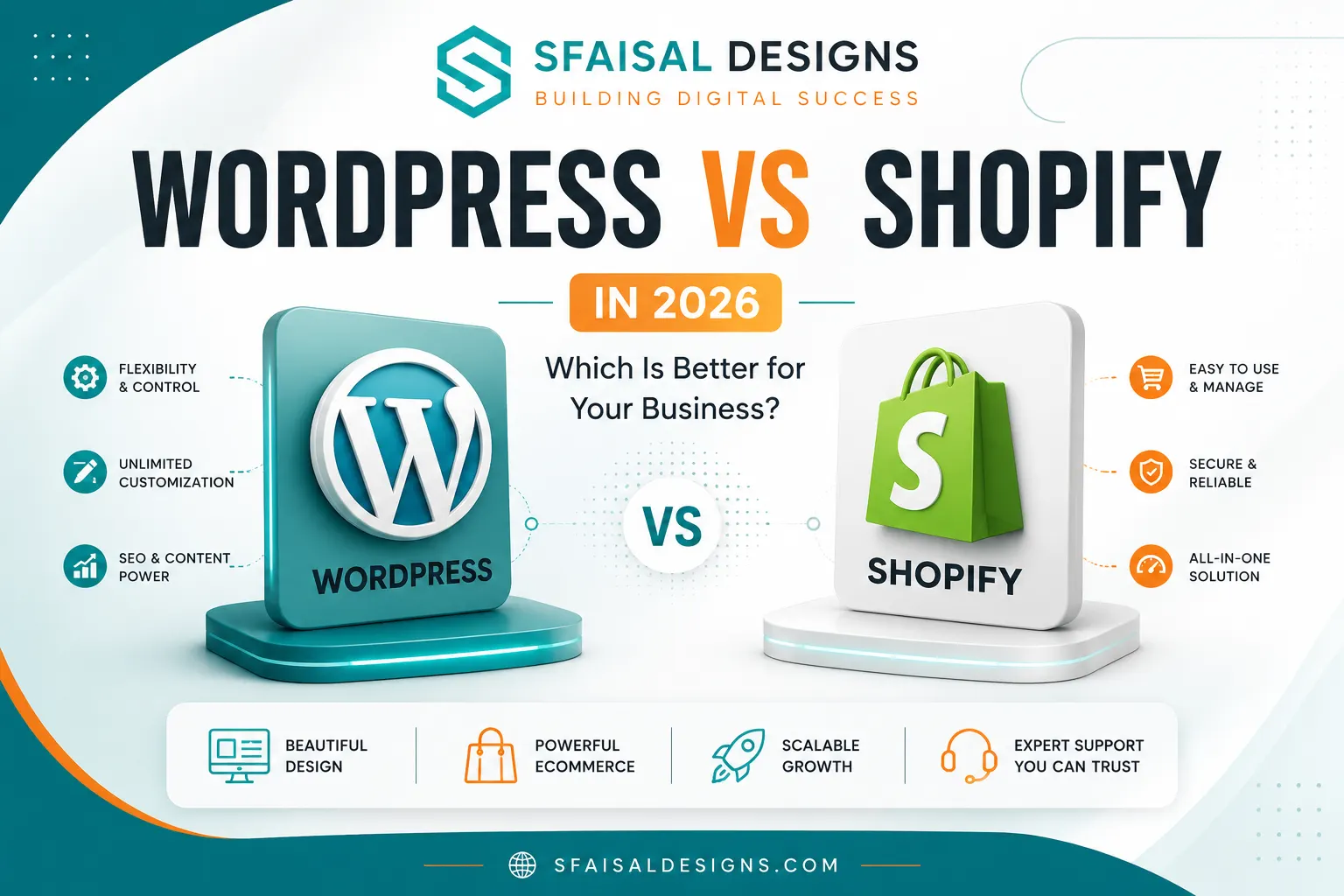
So, WordPress vs Shopify: which is better for your business in 2026?
The answer depends on what you’re building.
If you want maximum control, content flexibility, customization, and ownership, WordPress with WooCommerce can be an excellent choice. If your priority is launching and managing an ecommerce store with less technical maintenance, Shopify may be the better fit.
In this guide, we’ll compare WordPress and Shopify across design flexibility, ecommerce features, SEO, performance, security, costs, scalability, ease of use, and long-term business value.
WordPress vs Shopify: Quick Comparison
| Feature | WordPress + WooCommerce | Shopify |
|---|---|---|
| Platform type | Open-source CMS + ecommerce plugin | Hosted ecommerce platform |
| Best for | Flexible websites and customizable stores | Ecommerce-first businesses |
| Design flexibility | Excellent | Very good |
| Content management | Excellent | Good |
| Ecommerce | Excellent with WooCommerce | Excellent |
| Hosting | You choose your host | Included |
| Technical control | Very high | More limited |
| SEO flexibility | Excellent | Good |
| Plugin/app ecosystem | Very large | Very large |
| Maintenance | Owner/developer managed | Mostly managed |
| Scalability | Highly flexible | Highly scalable |
| Data/code control | High | More restricted |
| Ease of setup | Moderate | Easy |
| Best for content-heavy websites | Yes | Less ideal |
| Best for quick ecommerce launch | Good | Excellent |
The important point is that neither platform is universally “better.” They solve different problems.
What Is WordPress?
WordPress is an open-source content management system (CMS) that allows businesses to create and manage websites.
According to WordPress.org, the platform powers more than 43% of websites across the web. Its open-source architecture allows developers to customize the platform extensively.
WordPress itself is not primarily an ecommerce platform.
For online stores, businesses commonly use WooCommerce, an open-source ecommerce platform built for WordPress. WooCommerce provides tools for products, payments, shipping, variations, subscriptions, bookings, memberships, and other ecommerce functionality.
This distinction matters.
When people compare WordPress vs Shopify for ecommerce, they are generally comparing:
WordPress + WooCommerce
against:
Shopify
What Is Shopify?
Shopify is a hosted ecommerce platform designed specifically for businesses that want to sell online.
Unlike WordPress, you don’t need to separately purchase hosting and build the core ecommerce infrastructure yourself. Shopify provides the platform, hosting, security infrastructure, checkout, store management tools, and an app ecosystem within its service.
Shopify’s current plans include features for online stores, inventory management, multichannel selling, international commerce, analytics, and integrations.
This makes Shopify particularly attractive to entrepreneurs and businesses that want to focus on selling products rather than managing website infrastructure.
WordPress vs Shopify: Which Is Easier to Use?
Shopify Is Easier for Most Beginners
One of Shopify’s biggest advantages is simplicity.
You create an account, select a theme, add products, configure payments and shipping, and start building your store.
You don’t normally need to worry about:
- Finding separate hosting
- Installing WordPress
- Managing server software
- Updating WordPress core
- Updating WooCommerce
- Managing plugin compatibility
- Configuring many technical settings
Shopify handles much of the underlying infrastructure.
This makes it a strong choice for a business owner who wants to launch an ecommerce store quickly.
WordPress Requires More Management
WordPress gives you significantly more control, but that control comes with additional responsibility.
A typical WordPress ecommerce setup may involve:
- Domain
- Hosting
- WordPress
- WooCommerce
- Theme
- Plugins
- Payment gateway
- Security
- Backups
- Performance optimization
- Updates
This isn’t necessarily a disadvantage.
For businesses that have access to a professional WordPress developer or agency, the additional flexibility can be worth it.
Winner for ease of use: Shopify
Winner for control: WordPress
WordPress vs Shopify for Design Flexibility
Design is one of the biggest differences between the platforms.
WordPress gives developers extensive control over the website’s front end and back end.
You can build a website using:
- Gutenberg
- Elementor
- Bricks Builder
- Custom WordPress themes
- Custom PHP
- CSS
- JavaScript
- Custom plugins
- APIs
This means your website doesn’t have to look like every other website using the same platform.
For businesses investing heavily in branding, user experience, content marketing, or conversion optimization, this flexibility can be extremely valuable.
Shopify also offers professional themes and extensive customization options, but its architecture places more boundaries around what developers can change.
Winner for maximum design flexibility: WordPress
WordPress vs Shopify for SEO
SEO is another area where WordPress has a major advantage in flexibility.
WordPress allows you to control virtually every aspect of your content structure and technical SEO strategy.
You can optimize:
- Page titles
- Meta descriptions
- URLs
- Headings
- Internal links
- Schema markup
- XML sitemaps
- Images
- Blog content
- Category structures
- Landing pages
- Technical SEO elements
WordPress is particularly powerful for businesses that plan to build organic traffic through extensive content marketing.
For example, a business could create dedicated content clusters around:
WordPress Development → Website Design → Technical SEO → Website Speed → Local SEO
This makes WordPress particularly attractive to agencies, consultants, professional services companies, and businesses where informational content is an important part of lead generation.
Shopify also provides SEO capabilities and supports metadata, structured content, blogging, redirects, and other optimization features.
However, WordPress generally gives experienced SEO professionals more granular control.
Winner for SEO flexibility: WordPress
WordPress vs Shopify for Ecommerce
This is where Shopify becomes extremely competitive.
Shopify was built around ecommerce from the beginning.
Its platform includes tools for:
- Product management
- Inventory
- Checkout
- Payments
- Shipping
- Discounts
- Customer accounts
- Analytics
- Multichannel selling
- International commerce
Shopify also has a large app ecosystem for extending store functionality. Its current plans support integrations with thousands of apps and features for selling across multiple channels.
WooCommerce takes a different approach.
The core WooCommerce platform is open source and free, with additional extensions available for specific requirements. WooCommerce supports physical and digital products, subscriptions, bookings, memberships, variations, and numerous payment gateways.
This makes WooCommerce extremely flexible.
Shopify is better if:
You want a streamlined ecommerce platform with many essential features managed for you.
WooCommerce is better if:
You need a highly customized store integrated with a content-heavy WordPress website or other business systems.
Winner for simplicity: Shopify
Winner for customization: WooCommerce
WordPress vs Shopify: Cost in 2026
Cost is more complicated than comparing monthly subscription prices.
You should consider the total cost of ownership (TCO).
Shopify Costs
Shopify operates on subscription plans. Its current pricing page lists plans including Basic, Grow, Advanced, and Plus, with pricing varying by billing cycle and plan.
Depending on your plan and payment setup, you may also have:
- Payment processing fees
- Third-party transaction fees
- Premium apps
- Premium themes
- Additional services
The advantage is predictable platform infrastructure.
WordPress + WooCommerce Costs
WooCommerce’s core platform is free and open source.
However, a WordPress store may require:
- Domain
- Hosting
- Premium theme
- Premium plugins
- WooCommerce extensions
- Security tools
- Backups
- Developer support
- Maintenance
The final cost can therefore vary significantly.
A simple store can be relatively inexpensive, while a sophisticated custom WooCommerce store can require substantial development investment.
Which is cheaper?
There is no universal answer.
A business should compare the total cost of running its specific store, rather than assuming that “free” WooCommerce or a Shopify subscription automatically means lower costs.
Shopify itself publishes a comparison claiming lower average TCO for Shopify, while WooCommerce emphasizes the cost and flexibility advantages of its open-source model. Because both are vendor-published comparisons, their numerical claims should be treated as directional rather than universal benchmarks.
WordPress vs Shopify for Website Ownership
This is one of the most important differences for businesses thinking long term.
WordPress is open source.
You control your website files, database, content, and hosting environment.
WooCommerce explicitly describes its open-source model as giving merchants ownership of their store’s content and data.
Shopify is a hosted SaaS platform.
You operate your store within Shopify’s infrastructure and according to its platform rules, plans, APIs, and technical limitations.
That doesn’t make Shopify a bad choice. In fact, managed infrastructure is one of its biggest advantages.
But businesses should understand the distinction.
Choose WordPress if you value:
- Greater control
- Open-source software
- Custom development
- Hosting choice
- Data control
- Long-term flexibility
Choose Shopify if you value:
- Managed infrastructure
- Simpler operations
- Integrated ecommerce functionality
- Less technical maintenance
WordPress vs Shopify for Website Speed
Neither platform automatically guarantees a fast website.
Performance depends on implementation.
A poorly optimized WooCommerce website can be slow because of:
- Excessive plugins
- Poor hosting
- Large images
- Unoptimized databases
- Heavy themes
- Poorly written code
- Excessive scripts
Likewise, a Shopify store can suffer from:
- Heavy apps
- Large images
- Poor theme implementation
- Excessive third-party scripts
- Poorly optimized code
With WordPress, developers have extensive control over the performance stack, including hosting, caching, databases, code, images, and CDN configuration.
Shopify handles more of the infrastructure for you.
Winner for infrastructure simplicity: Shopify
Winner for technical control: WordPress
WordPress vs Shopify for Security
Shopify has an advantage in managed infrastructure.
The company handles much of the underlying platform security, hosting environment, and core infrastructure.
With WordPress, security becomes a shared responsibility between the website owner, hosting provider, developers, and plugin/theme vendors.
A professional WordPress security strategy should include:
- Secure hosting
- SSL
- Strong passwords
- Two-factor authentication
- Regular updates
- Backups
- Firewall protection
- Malware monitoring
- Least-privilege user accounts
WordPress isn’t inherently insecure.
The bigger issue is poorly maintained WordPress websites.
For businesses without technical resources, Shopify’s managed approach can therefore be attractive.
Winner for managed security: Shopify
WordPress vs Shopify for Content Marketing
If your business depends heavily on blogging, SEO content, educational resources, landing pages, guides, case studies, and content clusters, WordPress is particularly strong.
WordPress began as a publishing platform and has evolved into a flexible CMS. Its content-management capabilities make it suitable for businesses where organic content is a major acquisition channel.
For example, an agency could build a content ecosystem around:
- WordPress development
- Website design
- WooCommerce
- Technical SEO
- Local SEO
- Website speed
- Website security
- Website redesign
That makes WordPress an excellent choice for businesses using content + SEO + lead generation as a growth strategy.
Winner for content marketing: WordPress
Which Platform Is More Scalable?
Both platforms can scale.
The question is what kind of scaling your business needs.
Shopify is particularly attractive for businesses that want to scale ecommerce operations without managing the underlying hosting environment themselves.
WooCommerce is attractive when scaling requires deeper customization.
For example, a custom WooCommerce implementation can integrate with:
- ERP systems
- CRM platforms
- Shipping systems
- Inventory management
- Membership systems
- Subscription platforms
- Custom APIs
- Internal business software
WooCommerce describes its platform as suitable for high-volume stores while maintaining open-source flexibility.
For operational simplicity at scale: Shopify
For technical customization at scale: WooCommerce
For a small business, the decision should be based on the business model rather than company size alone.
Choose Shopify if:
- You primarily sell products.
- You want to launch quickly.
- You don’t want to manage hosting.
- Your team has limited technical expertise.
- You prefer an integrated ecommerce platform.
WordPress vs Shopify: Which Is Better for Small Businesses?
Choose WordPress if:
- Your website is more than a store.
- Content marketing is important.
- You need advanced customization.
- SEO is a major acquisition channel.
- You want full control over your website.
- You need custom integrations.
WordPress vs Shopify: Which Is Better for Service Businesses?
For service-based companies, WordPress is often the more natural fit.
Consider a:
- Law firm
- Real estate agency
- Healthcare company
- Marketing agency
- Construction company
- Consultant
- Professional services firm
These businesses may need:
- Service pages
- Location pages
- Blog content
- Case studies
- Team pages
- Lead-generation landing pages
- Contact forms
- Appointment booking
- Local SEO
- Google Business Profile integration
They don’t necessarily need a full ecommerce platform.
For these businesses, WordPress provides a powerful combination of CMS + design flexibility + SEO + lead generation.
When Should You Choose Shopify?
Shopify is an excellent choice when ecommerce is the center of your business.
Choose Shopify when:
- You want to launch quickly.
- You want managed hosting.
- You have limited technical resources.
- Your business primarily sells products.
- You want integrated ecommerce tools.
- You prefer a subscription-based platform.
- You want less responsibility for infrastructure maintenance.
Shopify’s current platform also includes tools for international selling, multichannel commerce, inventory, analytics, and AI-assisted commerce features.
When Should You Choose WordPress + WooCommerce?
Choose WordPress and WooCommerce when:
- You need maximum customization.
- Content marketing is important.
- SEO is a major growth channel.
- You want control over hosting.
- You need custom integrations.
- Your website needs extensive non-ecommerce content.
- You want an open-source ecommerce foundation.
- You have access to professional development and maintenance.
WooCommerce’s open architecture allows businesses to customize the storefront, functionality, integrations, and underlying code extensively.
WordPress vs. Shopify For Australian & New Zealand Businesses
The core WordPress vs. Shopify tradeoffs apply everywhere, but a few region-specific factors are worth weighing if you’re running a business in Australia or New Zealand specifically.
Payment gateways. Shopify has strong native support for region-popular payment methods like Afterpay in Australia, which can matter directly for conversion if your customers expect it at checkout. WooCommerce can support the same gateways through plugins, but it takes deliberate setup rather than coming built-in.
Local tax handling (GST). Both platforms can handle Australian and New Zealand GST correctly, but Shopify’s tax settings are more automated out of the box, while WooCommerce typically needs a tax plugin configured correctly for your specific region and product types.
Hosting and site speed. Site speed is affected by how far your hosting server is from your customers. Shopify runs on a global CDN by default, which generally performs well for AU/NZ traffic without extra setup. A WooCommerce store’s speed in this region depends heavily on choosing a host with servers in or near Australia/New Zealand, or configuring a CDN yourself — it’s not automatic.
Local support and developer availability. Both platforms have active developer communities in Australia and New Zealand, so finding local help isn’t a differentiator either way — but WooCommerce’s larger global ecosystem means slightly more available expertise overall.
Bottom line for AU/NZ businesses: Shopify’s regional payment and tax handling comes more “ready out of the box,” which can suit businesses wanting to launch fast with minimal setup. WooCommerce offers more control and lower ongoing platform costs, but region-specific setup (payments, tax, hosting location) needs to be handled deliberately rather than assum
WordPress vs Shopify: The Final Verdict
So, which is better in 2026: WordPress or Shopify?
There isn’t one answer for every business.
WordPress + WooCommerce is the better choice if you prioritize:
Customization + SEO + Content + Ownership + Flexibility
Shopify is the better choice if you prioritize:
Simplicity + Managed Infrastructure + Ecommerce + Faster Setup
The right platform should be selected based on your business model, technical requirements, growth strategy, budget, and long-term goals—not simply because one platform is currently more popular.
For a content-driven business, professional service company, or highly customized ecommerce operation, WordPress can provide exceptional flexibility.
For an ecommerce-first company that wants a managed platform and streamlined operations, Shopify can be an excellent choice.
Frequently Asked Questions
Is WordPress better than Shopify in 2026?
WordPress is better for businesses that need extensive customization, content marketing, SEO flexibility, and control over their website. Shopify is often better for businesses that prioritize a managed ecommerce platform and simple store operations.
Is Shopify better for ecommerce than WordPress?
Shopify can be easier to manage because ecommerce functionality and hosting are integrated into the platform. WordPress with WooCommerce can be better when an ecommerce business needs deeper customization, content management, or custom integrations.
Is WordPress cheaper than Shopify?
Not necessarily. WooCommerce itself is open source, but a WordPress store can require hosting, premium extensions, security, maintenance, and development. Shopify has recurring subscription costs and potentially additional app or transaction costs. Compare the total cost for your specific business.
Can WordPress compete with Shopify?
Absolutely. WooCommerce is a mature ecommerce platform with millions of stores and extensive customization capabilities. WooCommerce reports more than 4 million online stores using the platform.
Which is better for SEO, WordPress or Shopify?
WordPress generally provides more flexibility for advanced SEO and content strategies. Shopify has solid built-in SEO functionality, but WordPress gives developers and SEO professionals more control over content architecture and technical implementation.
Can I migrate from Shopify to WordPress?
Yes. Shopify stores can be migrated to WooCommerce, although the process requires careful planning for products, customers, orders, URLs, redirects, content, SEO metadata, and integrations.
Can I migrate from WordPress to Shopify?
Yes. A WooCommerce store can also be migrated to Shopify. The migration should be planned carefully to minimize downtime and protect existing organic search rankings.
Is Shopify or WordPress better for an Australian or New Zealand business?
Both work well in these markets. Shopify tends to have more region-specific features (like Afterpay) ready out of the box, while WooCommerce offers more control and lower long-term costs but requires more deliberate setup for local payments, tax, and hosting
Conclusion: Choose the Platform That Fits Your Business
The WordPress vs Shopify debate isn’t really about which platform is universally better.
It’s about choosing the right technology for your business.
Shopify makes sense when you want an ecommerce-first platform that handles much of the infrastructure for you.
WordPress + WooCommerce makes sense when you want a flexible website ecosystem where you can control the design, content, functionality, integrations, and technical architecture.
Before making your decision, consider five questions:
- Is ecommerce the primary purpose of your website?
- How much customization will you need?
- How important is SEO and content marketing?
- Who will manage the website?
- What will your business need three to five years from now?
The cheapest or fastest platform today isn’t necessarily the best long-term investment.
Your website should support your business strategy—not force your business strategy to fit the platform.
If you’re unsure whether WordPress + WooCommerce or Shopify is the right choice for your business, SFAISAL DESIGNS can help you evaluate your requirements and build the right solution around your goals.
Recommended Next Step
Explore your options before committing to a platform. If your business needs a highly customized WordPress website, WooCommerce store, SEO-focused website, or professional redesign, a strategic development approach can help you avoid expensive platform changes later.